Application service

TRUMPF Services turn laser equipment choices into controlled production decisions

Industrial laser purchases are rarely just machine purchases. They involve material behavior, fixture repeatability, operator routines, extraction, guarding, service access, and the digital records needed by production management. TRUMPF service planning starts with those facts and then narrows the discussion to cutting, marking, welding, engraving, or laser source options.

The purpose is to reduce uncertainty before capital approval. A team can bring sheet samples, thickness ranges, code readability targets, seam requirements, throughput goals, and automation assumptions into one structured review. The result is a clearer view of trial priorities, site preparation, training needs, and lifecycle support.
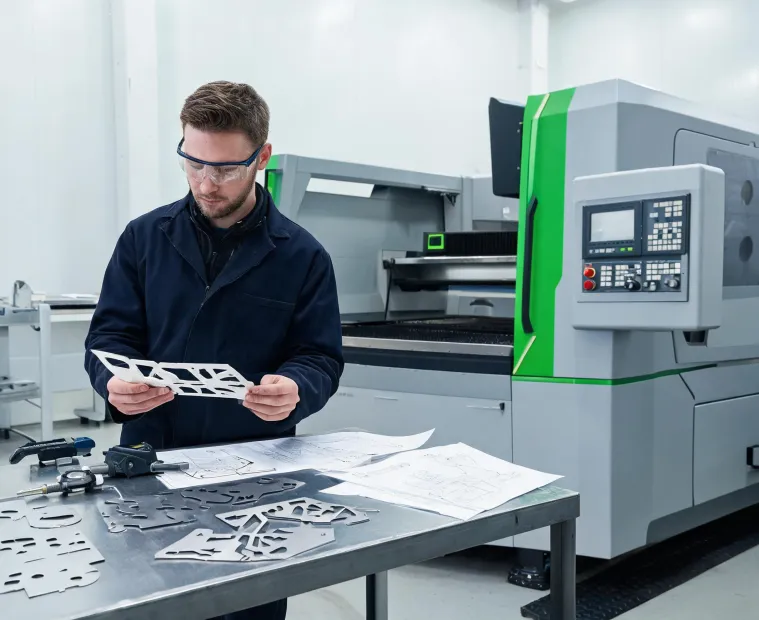
Engineer reviewing TRUMPF laser application plan
Service paths compared

Two-column service paths for teams comparing laser processes

01

Application trials

Cutting, marking, welding, and engraving trials focus on real materials rather than brochure limits. Sample programs document edge condition, heat effect, code contrast, seam penetration, and the inspection method your plant will use after installation.

02

Automation concept review

Engineers map loading, unloading, storage, robotics, safety enclosure, and data handoff requirements. This prevents a fast laser source from becoming constrained by part presentation or downstream handling.

03

Operator and maintenance training

Training covers beam parameter discipline, nozzle and optics care, assist gas checks, marking recipe control, fixture verification, and the warning signs that should trigger service attention.

04

Lifecycle service scope

Support planning identifies spares, preventive maintenance intervals, diagnostic access, software updates, and escalation paths for plants that run laser equipment across multiple shifts.

Decision questions

Inline FAQ for common laser equipment tradeoffs

These questions often reveal whether a team needs a cutting machine, a marking cell, a welding configuration, or a broader automation conversation. TRUMPF treats them as engineering filters, not sales scripts.

Bring material grade, thickness range, sheet size, expected edge quality, assist gas preference, part nesting examples, and any downstream inspection rule that would reject a cut edge.

A dedicated marking cell becomes practical when part identity, code verification, operator safety, and line takt time must be controlled as a repeatable production step.

Automation should be discussed before final machine selection because bed size, guarding, loading direction, part buffers, and software integration can change the practical equipment choice.

Before service review

Teams often compare kilowatts, work envelopes, and price lines without a shared definition of the production problem. The discussion can drift between cutting speed, code quality, weld strength, and automation concepts, leaving maintenance and safety teams to react late.

After service review

The application is separated into measurable requirements: material response, cycle time, inspection method, operator interaction, guarding, data flow, and service model. That structure allows procurement to compare laser equipment options with less ambiguity.

With inline form

Send the application facts that matter before a laser equipment quote.

Use the form to describe part material, thickness, production volume, marking or weld requirements, and any automation constraint. The first response can then address engineering fit instead of asking for the basics again.